Guide
Are stick vacuums good for carpet?
Published
Note: This page contains affiliate links. If you buy through them we may earn a commission at no extra cost to you. Learn more
In short
Yes, for most homes. A cordless stick vacuum with a motorised brush bar head cleans short and medium pile carpet well for everyday upkeep. The limits show on thick or shaggy pile, where you need more boost time, and boost cuts runtime sharply. For a deep clean of large carpeted areas, a corded upright still has the edge in sustained power and bin size.
Products for this job
Compare all 6 productsDyson V15 Detect Animal: auto power on carpet
Check price on AmazonAffiliate linkShark Stratos Pet Pro: DuoClean with dirt sensing
Check price on AmazonAffiliate linkDyson V10 Animal: torque drive head, 60 min
Check price on AmazonAffiliate link
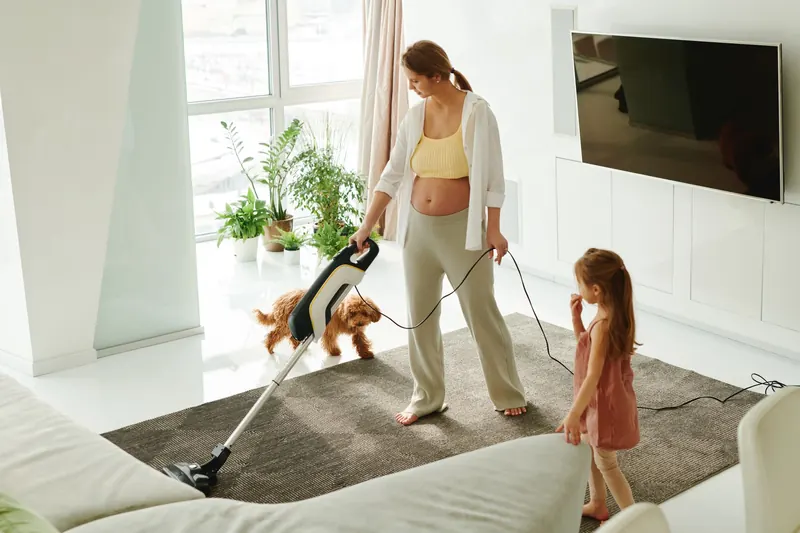
Carpet is where cordless stick vacuums used to struggle, and where the gap with corded machines has narrowed most. The floor head matters more than the badge on the handle: a stiff bristle brush bar driven by its own motor is what lifts grit and hair out of the pile. Suction alone only cleans the surface. This guide explains what a motorised head can and cannot do on different carpets, why boost mode is a trade-off rather than a free upgrade, how pet hair changes the picture, and when it is still worth keeping a corded upright in the cupboard for an occasional deep clean.
Why the floor head decides carpet performance
A stick vacuum cleans carpet with two things working together: airflow from the motor and agitation from the brush bar. On hard floors, airflow does most of the work because dust sits on the surface. Carpet is different. Fine grit and hair settle at the base of the fibres, and suction from above struggles to pull them out. A rotating brush bar with stiff nylon bristles flicks the pile, loosens what is trapped and throws it into the airflow.
Most mid-range and premium stick vacuums now ship with a motorised head that has its own small motor inside, so the brush spins at a set speed regardless of how fast air is moving. Cheaper machines sometimes use an air-driven turbo head, which slows down when the pile is thick. If carpet is your main floor, check that the main head is motorised and that it uses firm bristles rather than only a soft fabric roller. Soft rollers are designed for hard floors and do little for carpet pile.
Stiff bristle motorised head
Suits: Carpet pile and rugs
Soft roller head
Suits: Wood planks, laminate, vinyl
Anti-tangle conical bar
Suits: Tiles and mixed floors with pet hair
- Stiff bristle motorised head: the right choice for carpet and rugs.
- Soft roller head: for wood, laminate and tiles; limited agitation on carpet.
- Twin roller heads: some makers combine a soft front roller with a bristle bar, such as Shark's DuoClean head with two motorised brush-rolls, to cover both floor types.
- Anti-tangle or conical bars: designed to shed long hair, useful in homes with pets or long-haired people.
Short, medium and deep pile: what to expect
Most UK homes have short or medium pile carpet: twist pile, loop pile or a cut pile under about a centimetre. A good motorised stick head handles these well in its normal or auto mode. You should see the pile lift and the bin collect fine grey dust as well as visible crumbs.
Deep pile and shaggy rugs are harder. Long fibres can wrap round the bar, the head can sink and drag, and the motor has to work harder to keep airflow moving through dense material. Some heads struggle to push forward on very thick rugs. Here a stick vacuum still copes, but you will usually need slower passes, more time on boost and sometimes a second pass in a different direction. Loop pile, such as Berber, needs care too, as a fast brush bar can snag loose loops. Check the carpet maker's care advice and, if your head allows it, reduce brush speed or use a non-motorised tool on delicate loops.
| Carpet type | Typical result | Mode to start with |
|---|---|---|
| Short twist or cut pile | Cleans well with a motorised head | Eco or auto |
| Medium pile | Cleans well with slower passes | Auto, boost on walkways |
| Deep pile or shaggy rug | Possible but slower, more boost needed | Boost in short bursts |
| Loop pile (Berber) | Works, but watch for snagging | Low or auto, check carpet care advice |
Boost mode and the runtime trade-off
Every stick vacuum advertises a headline runtime, and it is almost always measured in the lowest power mode with a non-motorised tool fitted. Shark, for example, quotes up to 60 minutes for the Stratos Pet Pro in ECO mode with a non-motorised tool, and up to 50 minutes for the PowerPro on the same basis. Dyson lists 60 minutes for the V15 Detect Animal and 40 minutes for the V8 range. Put the motorised carpet head on and move to a higher mode, and that figure drops a long way.
Boost is the setting that does the heavy lifting on carpet, but it typically runs for a small fraction of the eco time. That is why automatic modes help. Dyson's High Torque head on the V15 Detect monitors brush bar resistance 360 times a second in Auto mode and adjusts power across floor types, and Shark's Clean Sense IQ adjusts power when it senses dirt. Both aim to spend battery where it is needed rather than running flat out all the time.
If your home is mostly carpet, plan around the realistic carpet runtime, not the eco headline. Our runtime planner lets you enter rooms, minutes per room and the share of time on boost to see whether one charge covers the job. A model with a removable or second battery helps on large carpeted homes; see the cordless vacuums with swappable batteries guide.
Pet hair on carpet
Pet hair weaves itself into carpet fibres, which makes it one of the harder jobs for any vacuum. A motorised head with firm bristles is essential. Long hair also wraps round brush bars, which reduces agitation and can strain the head motor over time. Anti-tangle designs reduce that. Dyson's V15 Detect Animal uses a de-tangling comb on the High Torque head, and Shark's PowerDetect Cordless Pet has an Anti Hair Wrap Plus brush-roll with a chevron pattern and internal combs. You can read how these differ in anti hair wrap and anti-tangle heads explained.
For stairs and upholstery, a mini motorised tool in handheld mode does more than a crevice or brush tool. Our best cordless vacuums for pet hair guide lists models that include one.
When a corded vacuum still helps
A cordless stick vacuum is ideal for quick, frequent cleans: a few minutes on the hallway runner, the living room rug before guests arrive, the stairs once a week. Little and often keeps grit from grinding into the pile. For a full deep clean of a large, carpeted house, a corded upright still has advantages. It can run at full power for as long as you need, it usually has a bigger bin and a wider head, and you never stop halfway because the battery runs out.
Many households keep both: a stick vacuum for daily use and an older corded upright for a monthly deep clean or after decorating. If you are deciding between the two, see cordless vs corded vacuum and stick vacuum vs upright.
Getting the best carpet results from a stick vacuum
- 1
Fit the motorised carpet head, not the soft roller, before starting on carpet.
- 2
Empty the bin before you start. A full bin and a clogged cyclone reduce airflow.
- 3
Check the brush bar for wrapped hair and threads and clear them with the battery removed or the machine switched off.
- 4
Use auto or eco on light areas and save boost for walkways, doormats and under the dining table.
- 5
Move slowly. A pass at walking pace lets the brush bar work. Overlap each stroke slightly.
- 6
Vacuum high traffic areas in two directions once a week to lift flattened pile.
- 7
Wash or replace filters as the maker advises, so airflow stays strong.
Frequently asked questions
Can a stick vacuum replace my upright on carpet? For many smaller homes with short or medium pile carpet, yes. A motorised stick head handles everyday cleaning well. In larger, fully carpeted homes or with deep pile, a corded upright remains useful for longer deep cleans because it never runs out of charge.
Is a soft roller head any good on carpet? Not really. Soft roller heads are designed for hard floors, where they pick up fine dust and larger debris without scattering it. On carpet they provide little agitation. Use the bristle head for carpet and rugs.
Why does my stick vacuum run out so quickly on carpet? Headline runtimes are usually measured in eco mode with a non-motorised tool. A motorised carpet head and boost mode both draw much more power, so runtime on carpet is much shorter. Auto modes, a second battery or planning with our runtime planner all help.
Which stick vacuums are best for carpet? Look for a motorised head with stiff bristles, an anti-tangle design if you have pets, and enough runtime on carpet for your home. Our best cordless vacuums for carpet guide compares models on these points.
What you need
- Check price on AmazonAffiliate link
Dyson V15 Detect Animal: sensor-led suction, 60 min
- Check price on AmazonAffiliate link
Shark Stratos Pet Pro: 2.16 kg in use, removable battery